
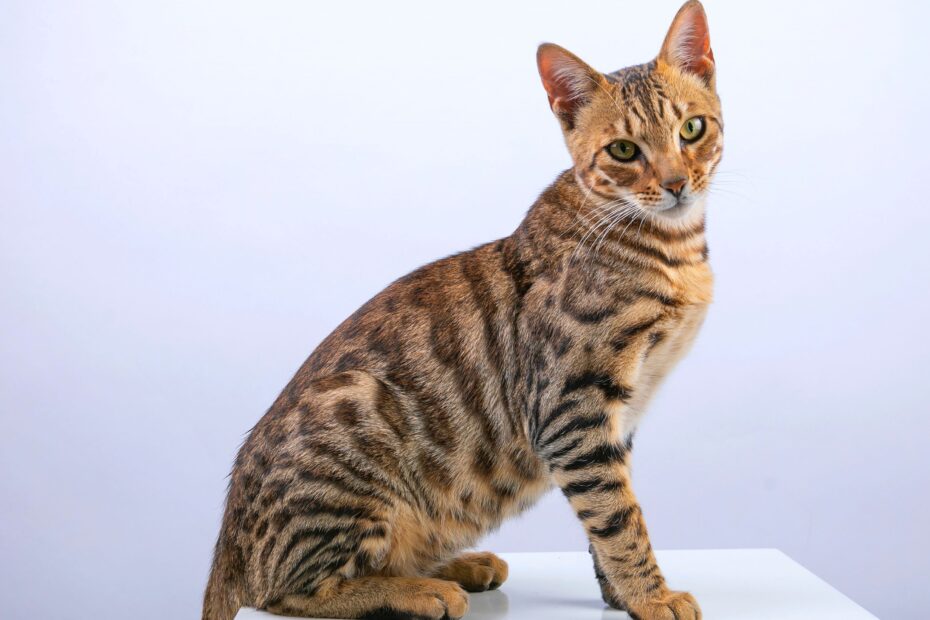
Bengal cats are difficult to overlook. Their striking appearance and wild cat features make them a popular breed among cat enthusiasts. However, the exotic looks give way to a domestic cat that is playful, intelligent, and affectionate. For many cat enthusiasts, Bengal cat size is another important factor when considering this breed.
At Wildmark Whisks, many families inquire about the adult appearance of their Bengal kittens. They want to know the potential size of their kitten, the ideal weight of a Bengal cat, and if their coat will change as they age.
So, how big do Bengal cats get?
Most Bengal cats grow to be medium to large in size. However, the actual size of an adult Bengal cat can vary significantly based on a variety of factors.
This guide provides information on the average size and weight of a Bengal cat, physical features of the breed, the various colors of Bengal cats, and the differences between their spotted and marbled coats. The CFA Bengal breed standard provides further details about the breed’s distinctive coat patterns and physical characteristics.
How Big Do Bengal Cats Get?
Bengal cats are generally medium to large in size compared to other domestic cats. Their long, muscular bodies often make them appear larger than their actual weight.
Most Bengal cats measure between 13 and 18 inches in length, excluding their tails. Their tails can measure between 10 and 12 inches in length.
Bengal cats that are male often tend to be larger and heavier than Bengal cats that are female. Male Bengal cats tend to have broader chests and a more muscular build than their female counterparts.
Many Bengal cats will appear to be near their full size by the time they are one year old. However, Bengal cats tend to continue developing physically until they are around two years old.
Some of the factors that may influence the final size of a Bengal cat include:
- Its genetics and the size of its parents
- Its sex
- The type of nutrition it receives as a kitten and adult
- The level of activity it engages in
- Its overall health
- Its age when it reached maturity
By observing the size of a Bengal cat’s parents, owners may be able to make an educated guess about the size of their kitten as it matures. However, no breeder can guarantee the size of a kitten as it matures into an adult cat.
Average Bengal Cat Weight
Bengal cats generally weigh between 8 and 15 pounds. Some male Bengal cats will weigh significantly more than this average range, while female Bengal cats may weigh less.
The average weight of an adult Bengal cat is:
Female cats
8 to 12 pounds
Male cats
10 to 15 pounds
Some of the largest Bengals
16 pounds or more
While these weights are general guidelines for Bengal cats, each cat’s ideal weight will be different based on its individual size and build.
Due to the muscular nature of Bengal cats, they may feel heavier than other cats when they are picked up. However, their weight is generally in line with their size.
Healthy adult Bengal cats will have a visible waist when viewed from above. Owners should be able to feel the ribs of their Bengal cats, but the ribs should not be visible.
Rather than focusing on the ideal weight of a Bengal cat, owners should focus on the overall health and condition of their feline companions. Sudden changes in the weight of a Bengal cat should be reported to a veterinarian.
At Wildmark Whisks, we focus on the health and care of our Bengal cats and kittens. To learn more about the care of Bengal cats, visit our Bengal kitten health and care page.
What Does a Bengal Cat Look Like?
Bengal cats have long, muscular bodies with long legs and large paws.
The hind legs of a Bengal cat are often longer than the front legs, which allows for their impressive athleticism.
Bengal cats generally have a small head in relation to their bodies. Some of the features of a Bengal cat’s head include:
- A broad muzzle
- Whisker pads
- High cheekbones
- A chin
- Rounded ears
- Large eyes
The eyes of Bengal cats can be a variety of colors, including green, gold, yellow, hazel, blue, and aqua colors.
Bengal cats have short, dense, soft fur. Some Bengal cats have a shimmering quality to their fur, known as “glitter” in the cat world.
This glitter effect allows Bengal cats’ fur to reflect light and appear as if dusted with gold or silver. While an attractive feature, it is not a requirement for Bengal cats to have this glitter in their coats.
To view the Bengal kittens that are currently available at Wildmark Whisks, visit our available Bengal kittens page.
Popular Bengal Cat Colors
Bengal cats are available in a variety of colors. While coat color may be an important factor to some owners, it should never be the only consideration when selecting a Bengal cat.
Brown Bengal Cats
Brown is one of the most common colors of Bengal cats.
Brown Bengal cats have a background color that ranges from light tan to deep brown. Their spots and markings range from brown to black.
Brown Bengal cats tend to have eyes that are green, hazel, yellow, or gold in color.
Some brown Bengal cats may change their color as they age into adulthood. Their background color may become more golden, and their spots may become more defined in color.
Snow Bengal Cat
Snow Bengal cats have pale background colors that range from white to cream to beige. Their spots range from light tan to dark brown.
Snow Bengal cats come in several genetic varieties, including:
- Seal lynx point Bengal cats
- Seal mink Bengal cats
- Seal sepia Bengal cats
Seal lynx Bengal cats have blue eyes, while seal mink Bengal cats have aqua or blue-green eyes. Seal sepia Bengal cats have green, gold, or hazel eyes.
Some snow Bengal kittens may have very light-colored spots and markings. As they mature, their spots become more pronounced.
Because their coats continue to develop with age, owners should not judge a snow Bengal cat based on the appearance of their kitten photographs.
Silver Bengal Cat
Silver Bengal cats have white, pale gray, or metallic background colors. Their spots are typically dark gray or black in color.
Unlike Bengal cats of the brown variety, silver Bengal cats do not have any golden colors in their coat.
Silver Bengal cats have green, yellow, gold, or hazel eyes.
Some Bengal cats carry other color genes. These genes allow for the creation of silver snow Bengal cats or silver charcoal Bengal cats.
Their colors appear particularly dramatic in the daylight and in photographs of these cats.
Blue Bengal Cats
Blue Bengal cats have soft blue-gray coats with dark gray spots.
This color is much less common than brown, silver, or snow Bengal cats.
Their soft blue coats have a more understated and elegant look to them.
Blue Bengal cats may have a peach-colored or cream-colored undertone to their coat.
Charcoal Bengal Cats
Charcoal Bengal cats have deep colored spots and markings.
Their facial markings often look like dark glasses, while their back may have a dark stripe.
This coloration can occur in cats with brown, silver, or snow backgrounds.
This means that a Bengal cat can be both charcoal and another color at the same time.
Spotted Versus Marbled Bengal Cats
Bengal cats have coats that are either spotted or marbled.
Understanding the difference between these two types of coat patterns will allow owners to select the type of Bengal cat that they prefer. However, the coat of a Bengal cat does not relate to their personality.
A Bengal cat with a spotted coat will not have a different temperament than a Bengal cat with a marbled coat.
Spotted Bengal Cats
Spotted Bengal cats have individual spots on their bodies. Their spots may be simple spots, arrowhead shapes, paw-prints, or rosettes.
Rosettes are spots that have two or more different colors within them.
These rosettes resemble the spots that are found on wild cats like leopards and jaguars.
Some of the different types of rosettes include:
- Donut rosettes
- Paw-print rosettes
- Arrowhead rosettes
- Clouded rosettes
Some people like the look of spots and rosettes that run horizontally across the Bengal cat’s body instead of in vertical rows. A strong contrast between the spots and the background color can make the cat stand out more dramatically.
However, each Bengal cat has a different coat pattern. No two Bengal cats have the same arrangement of spots or rosettes.
The coat pattern of a Bengal kitten may change as the cat grows. The markings may appear fuzzy and unclear at some stages of the cat’s development before becoming more pronounced and clear as the kitten matures.
Marbled Bengal Cats
Marbled Bengal cats have broad markings that run along their coat instead of having individual spots.
The patterns on the coat of a marbled Bengal cat can resemble polished stone, smoke, ribbons, or the flowing movement of water. The best marbled Bengal cats have markings that run horizontally along their bodies and have multiple colors in their markings.
Like spotted Bengals, the coat of a marbled Bengal kitten may change as the cat matures. A marbled pattern that looks light and crowded in photographs of the kitten’s early life can become more defined and darker as the Bengal cat grows into adulthood.
Some marbled Bengal cats will have high contrast between the marbled markings and the background color of their coat. Other marbled Bengals will have a softer appearance.
Choosing a Bengal cat with either spotted or marbled patterns is mostly a matter of personal preference. Both types of Bengal cats are beautiful and have the same intelligence and playfulness.
You can learn more about the personality of Bengal cats in our Bengal cat personality and temperament guide.
Does Bengal Cat Size Depend on Generation?
The size of a Bengal cat does not depend on its generation. However, some characteristics of the cat, such as its facial features and body length, may be more apparent in early generations of Bengal cats.
Nevertheless, the individual genetics of the kitten is more important in determining its adult size. Two kittens from the same litter can have different growth rates and adult sizes.
Other factors that can influence the size of an adult Bengal cat include its sex, the size of its parents, its nutrition, health, and activity level.
If you are interested in purchasing a Bengal cat of a specific generation, you can view the F3 and F4 Bengal kittens for sale at Wildmark Whisks.
Choosing a Bengal Based on More Than Appearance
While the appearance of Bengal cats is certainly beautiful and diverse, there are other factors to consider when choosing a kitten to bring into your home.
Consider the personality and lifestyle of the kitten. Different kittens have different personalities and levels of activity. Some may do well in active homes with lots of playtime, while others may do better in more relaxed households.
At Wildmark Whisks, we observe our kittens carefully as they develop to learn their personalities and their compatibility with different types of families.
We do not want to simply place the kittens in any home that will accept them. We want each Bengal kitten to be placed in a home where they will feel secure and loved.
Meet the Available Kittens at Wildmark Whisks
Each kitten at Wildmark Whisks has a unique combination of features and personality traits.
Whether you like spotted brown Bengal kittens, marbled Bengal kittens, snow Bengal cats, or silver Bengal cats, it is important to choose a Bengal kitten that is healthy and well socialized.
Wildmark Whisks takes care of our Bengal kittens in a way that ensures they develop good health and a proper temperament before finding their way into appropriate homes.
Visit our available Bengal kittens page to view the kittens currently available for adoption and to learn more about their personalities.
Ready to Find Your Bengal Companion?
Call to Action: View Available Bengal Kittens
Because the availability of Bengal kittens can change quickly, you can also use our contact page to inquire about specific kittens, pricing, reservations, and transportation.
Final Thoughts
So, how big do Bengal cats get?
Most Bengal cats grow to weigh between 8 and 15 pounds. Their long bodies and powerful stature can make them appear larger than a typical domestic cat.
The beauty of Bengal cats is not limited to their size and weight. Characteristics such as the color of their eyes, the shape of their face, the texture of their coat, and the colors and patterns of their markings all add to their unique appearance.
Whether you choose a spotted, marbled, snow, or silver Bengal cat, each kitten will have its own unique look.
The best Bengal cat is not one with the biggest rosettes or the rarest color. The best Bengal cat is one that is healthy, well socialized, and best suited to your household.